Friday, May 24, 2013
   
Text Size
Banner

So You Want To Make A Knife?

Feature Articles - How-To Articles

There is something very primal about holding a well made knife.  It has been called the “Riddle of Steel” by many.  I think the attraction of a bladed tool, is a throw back to our more primitive days.  You know, the days when having a trusty knife could be the difference between eating or not, between life and death, between providing shelter, or being in the elements.  As time has moved forward, the one knife for all tasks has given way to the specialized tools we have today.  There is a knife for every occasion, and for every type of task.

I grew up on a ranch, using a knife daily for a variety of chores.  A strong dependable belt knife was, and is, a near daily fixture on my belt.  I have many to choose from, yet always grab one of a select few.  I have found that over time I prefer the unique look and feel of a hand made blade.  There may be a few small imperfections, but I see those as character, and they endear the knife to me.

A while back I started wishing knives had this feature or that feature, or a combination of certain features.  That naturally led me to designing my own.  In designing your own knife you can combine the best of many worlds.    Not to mention, it is really entertaining.  Once you design the knife, how do you bring it to life?  You can contact a custom maker with your design, or make it yourself.  That is what we will cover today, making a custom knife from an old metal file. All tools used will be easy to find and acquire for around $150, or less.

The first step is to acquire an old file.  After having the file, you need to anneal it. This picture shows the file after it has been annealed and allowed to cool.  When you anneal metal, you are heating it to a very high temperature and allowing it to cool slowly.  This will make the metal soft enough to cut and shape. Annealing can be done in a very hot camp fire.   You want to heat the metal to a point where it is glowing yellow-orange.  Then allow the metal to cool slowly.  I allow the fire to die, and retrieve the file after all has cooled.

The file is sanded and is then ready to be shaped into a knife blank.  I have used a hack saw to cut out knives, but for this one I used a 4” angle grinder. You can pick one up from Harbor Freight for around $18.  It is not as quick as a plasma cutter, but it will get you there.  Some of the other tools that are used are a bench grinder, drill/drill press, scroll saw, and a 1x30 belt sander.  All can easily be found at your local hardware store.

Here the knife is shown after being shaped, sanded, tang holes drilled, and a rough convex edge put on the blade.  You need to have most of the work done before hardening.  I like to finish the edge after hardening, and before tempering. For this knife I tried to hold the blade at about a 15 degree angle, with the 1x30 belt sander grinding from the spine down.  On more expensive and specialized grinders, you can grind the blade from the edge side.  It takes a bit more practice, and you will cut a few belts learning, but a worth while technique.  For the 1x30 machine, the spine down grinding technique works better, and is safer. The 15 degree grind will put a very strong cutting geometry onto the blade, but will still slice very nicely. From here, the knife is ready for the forge.

The forge that I build is a very primitive and simple design.  It is, however, very effective.  I begin by creating the space.  I have sectioned off a portion of an established fire pit.  I build the walls with rocks and then pack the gaps with ash and dirt.
In this photo, you can see the walls have been built, packed with dirt, and the screen is in place.  The pipe you can see running under the screen goes to an air pump, which acts like a bellows.  The pipe runs under the screen, so the oxygen will flow up through the coals.

With the forge built, it is then filled with a 20lb bag of charcoal.  I prefer the type without an accelerant added, as the accelerant seems to increase the forging scale significantly.  Allow the charcoal to heat evenly and approach a white color.  That is when I put the blade in to begin the hardening.  Allow the blade to reach a nice light orange color.  This will take about 20-30 minutes.  Once at that color, it is time to start the air pump.

As can be seen, when the pump is turned on, the heat cranks, and the flames grow.  Watch the blade carefully.  When the metal reaches a light yellow/orange color, and seems somewhat translucent, it’s time to check.  Pull the blade from the coals and put a magnet up to it.  If the metal is nonmagnetic, it’s time to quench.

I have a bucket of old motor oil ready to go.  Plunge the blade vertically, and as even as you can, into the waiting oil.  I always wear very thick welding gloves to protect my hands from the high heat. I will stir the oil with the burning blade until the flames go out.  You can then rest the blade against the side of the container, without worry of the blade warping.  Allow the blade to cool in the oil, and then remove.


The blade stayed straight, and is ready to be cleaned and tempered.  I tempered this blade with a propane torch. I used the torch and heated the blade from the spine side.  Do this in a very even manner.  You, almost, paint the spine with the torch until the metal turns the color of wheat.  Be careful not to over heat your blade and ruin the hardening.  You can take the metal to a light blue color and still be ok.

This Photo clearly shows the wheat color the metal takes on from the tempering.  Also, notice the file pattern at the top of the blade. On some knives I like to leave a bit of the file pattern on the blade, so it is obvious where the metal came from.   After cleaning the blade and finishing the grind, I start on the handle.  The handle is traced onto the wood to be used.  For this knife I took a couple pieces of old oak hardwood flooring, and ripped the top 1/4” off.  I then cut the scales using a scroll saw.

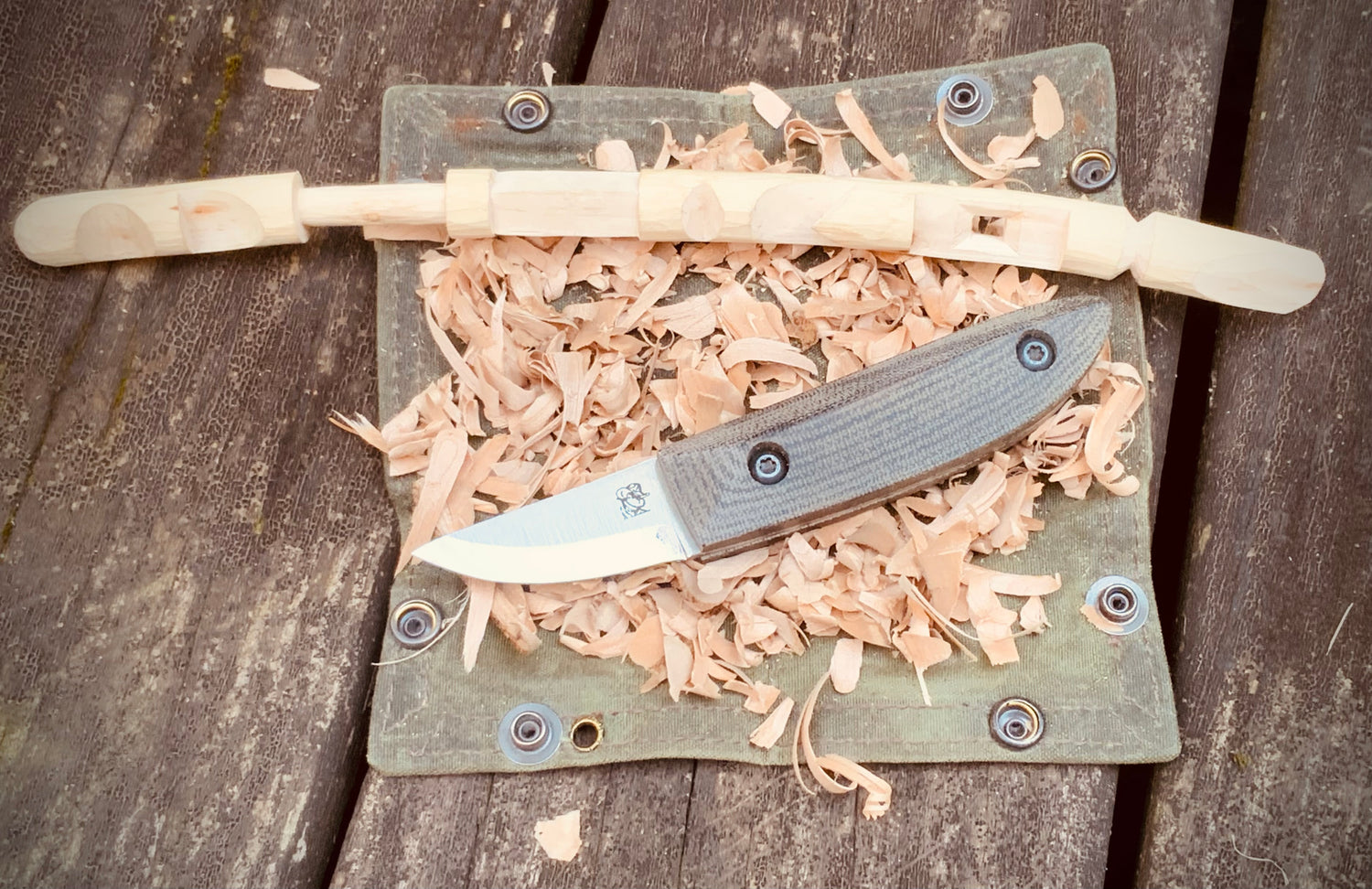
Finished knife ready for testing...Once the scales are cut to the shape of the tang, I attach them with flat head socket cap screws and a threaded stand off.  I also use epoxy under the slab, for a permanent hold. Here the knife handle has been sanded, sealed, and I am testing the balance.  The balance is on the first finger, where I wanted it.  This knife is ready to be tested.

For the readers, I have done a quick side-by-side comparision of this particular knife with some of my other commercial blades.  Below are some comments and observations about this knife along with some additional pictures as well.

Review:

The blade length is 5”, the thickness is 3/16”, and the handle is 4.5”.  I see this knife as being a great camp knife used for a variety of chores.

I cut 120, 8-9” length pieces of card board to test edge retention.  The knife was still shaving paper after the cuts had been made.  Let’s do some chopping (bottom).  The file knife easily chopped through the branch, making a batton for my next activity.  I started with a seasoned 2x6, and ended with a nice pile of kindling.  The blade of the knife is very stout and I don’t foresee any difficulty battoning through seasoned wood.


The last little test performed was a drilling test (bottom).  The spear point on the knife lends itself to drilling and bushcraft very well.  In conclusion, I feel that the knife turned out very well.  I wanted to create a knife that would work well for bushcrafting and camp chores.  I think I was successful in my attempt.

Editor's Note:  Please keep in mind that this is the method used by the author to make his own knives.  Do your own research to find what method best works for you.  Always remember to wear the proper safety equipment such as gloves, eyeshields, and non-flammable clothing when working on projects such as this.


Good luck with your own knife-making project!!

Like Woods Monkey? Share it!

Featured Sites

Turn The Payge
Payge McMahon is an adventure athlete and journalist who travels the world inspiring others to get outdoors, try new things and start checking off that bucket list. She has climbed in the Himalaya, summited the highest mountains in Africa, Japan and the continental United States, cycled through Thailand, Cambodia and Vietnam, backpacked across Northern Spain, the Inca Trail to Machu Picchu and California’s 221 mile John Muir Trail. She has trekked through the deserts of Egypt and Jordan, the Amazon Rainforest and the list goes on! She is an expert in travel and many things outdoors. She writes for numerous magazines including National Geographic Adventures, Self Reliance Illustrated, Woods Monkey, Her Nashville and Her Look. To follow her latest adventures click the link above or go to www.facebook.com/paygemcmahon
Canteenshop.com
Thank you for choosing CanteenShop.com. We are happy to now be one of the best suppliers of unique Wilderness and Bushcraft gear on the Internet! Our selection of gear is hand picked by us after being well tested in the field. We offer items not found anywhere else on the internet, and provide you with Gear Reviews, Bushcraft, and Camp Cooking information with our videos at the CanteenCorner on YouTube.
Wilderness Learning Center
If you're looking for a top-notch school to learn outdoors skills, then you'll want to take a look at the Wilderness Learning Center. It's a school with knowledgeable instructors, a great location, and excellent facilities for learning in the outdoors!
Knife Forums
One of the premiere communities for people to gather and communicate about all types of blades.
Scott's Knots
If you're looking for custom paracord work for things like fobs, survival bracelets, baldric rigs, or just a lanyard, Scott's Knots will meet your needs. Take it from folks that have several pieces of his work in use every day, you won't be disappointed!
Blade Forums
Another premiere site for users to communicate about and trade information and goods related to knives.
American Bushman
Here's a site that's been around awhile and provides a lot of useful information regarding various outdoors topics. The author has a nice writing style and a good amount of knowledge to share. Spend some time here and I guarantee you'll learn something new!
Going Gear
Here's a great site for essential outdoors gear--especially some great custom-handled fire steels! There's a good number of sizes and customization features that should easily meet your needs!